
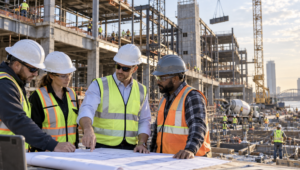
Major construction has always demanded coordination, but the scale of that challenge has changed. Airports, hospitals, data centers, manufacturing facilities, universities, mixed-use developments and public infrastructure projects now bring together more specialized contractors, consultants, technology platforms, regulatory requirements and financing considerations than many owners can reasonably manage on their own.
That complexity is changing the way major projects are organized. Instead of relying solely on architects, engineers and general contractors to move a project from design through completion, more owners are placing an experienced representative directly on their side of the table. The role creates a central point of oversight focused on the owner’s objectives rather than the interests of any individual designer, contractor or supplier.
The concept is not entirely new. What is changing is the importance being placed on it. As projects become larger and more technically demanding, independent Owners Rep Construction is moving closer to the center of project delivery.
Major Construction Has Become a Management Challenge
A large project can involve hundreds of companies and thousands of individual decisions. Long before construction crews arrive on site, owners may be dealing with feasibility studies, budgeting, land issues, environmental reviews, design consultants, permitting, procurement strategies, scheduling and financing.
Once construction begins, the number of moving pieces grows dramatically. Subcontractor schedules overlap. Materials must arrive at the right time. Design changes can affect work that has already been priced or installed. Inspections have to be coordinated. Requests for information move between architects and contractors. Change orders need to be evaluated before they begin consuming contingency funds.
The scale of the U.S. market illustrates why managing these decisions matters. According to the U.S. Census Bureau’s Construction Spending program, total U.S. construction spending was running at a seasonally adjusted annual rate of about $2.16 trillion in July 2026. Public construction alone accounted for more than $543 billion at an annualized rate.
With that amount of capital moving through the industry, even relatively small percentage changes in cost or schedule performance can represent substantial amounts of money on a major project.
The Owner Needs a Dedicated Voice at the Table
Architects have contractual responsibilities. Engineers have defined scopes. General contractors oversee construction operations and subcontractors. Specialty consultants focus on their individual disciplines.
The owner, however, remains responsible for the larger investment.
That distinction explains the expanding role of the owner’s representative. The representative works across the project rather than within a single trade or discipline, helping connect decisions made during planning, design, procurement and construction with the owner’s broader objectives.
The Construction Management Association of America describes professional construction management as a service that helps owners manage schedule, cost, quality, safety, scope and function. CMAA also emphasizes that the construction manager representing the owner provides oversight across the project while working with the architect, engineer and contractor.
That owner-centered perspective becomes especially valuable when difficult decisions arise. A proposed substitution may save money today but create maintenance problems later. An accelerated schedule may support an important opening date but introduce additional costs. A design revision may improve the finished facility while disrupting procurement.
Someone has to evaluate those tradeoffs from the owner’s point of view.
Early Involvement Is Changing Project Delivery
One of the most significant shifts in major construction is happening before a shovel reaches the ground.
Experienced owner representatives are increasingly involved during planning and design rather than being brought in after problems appear during construction. Early involvement allows management decisions to be made while there is still time to change direction without the expense associated with modifying completed work.
During preconstruction, an owner’s representative may participate in budget development, constructability reviews, consultant coordination, contractor procurement, schedule creation, risk identification and design reviews. The objective is not to replace architects, engineers or contractors. It is to make sure the work of those parties remains aligned with the owner’s priorities.
Wikipedia’s overview of construction management describes construction management as the application of project management techniques to planning, design and construction, with a focus on scope, time, cost and quality. Those principles become increasingly important as projects move through multiple phases and delivery methods.
Decisions made early can have consequences years later. A poorly coordinated mechanical design may create installation conflicts. An incomplete procurement strategy may expose a project to long lead times. Unrealistic scheduling assumptions can eventually become expensive acceleration efforts.
Finding those issues before construction is often far less disruptive than solving them in the field.
Cost Control Has Become More Important as Construction Prices Shift
Cost management has always been part of construction, but volatile material and labor conditions have made it even more important.
The Associated General Contractors of America reported in July 2026 that the producer price index for inputs to new nonresidential construction was 7.1 percent higher than a year earlier. AGC’s analysis also found that input costs were rising faster than contractors’ bid prices for new nonresidential buildings during the period.
Conditions like these make a construction budget something that must be actively managed rather than simply approved.
Owner-side oversight can include reviewing estimates, monitoring contingency, analyzing proposed changes, examining payment applications and tracking commitments against the overall project budget. It can also provide an additional level of scrutiny before a decision becomes a signed change order.
The goal is not simply to reduce spending. A successful project still has to meet its operational, technical and quality requirements. Effective cost control means understanding where money is being spent, why it is being spent and how each decision affects the complete project.
That visibility is especially important on large projects where hundreds of individual changes can gradually alter the financial picture.
Schedule Oversight Is Moving Beyond the Contractor’s Timeline
Construction schedules have become increasingly sophisticated. A master schedule can include design milestones, permit approvals, equipment procurement, subcontractor activities, inspections, commissioning and turnover requirements.
The contractor’s construction schedule remains essential, but an owner often has deadlines that extend beyond the contractor’s work.
A hospital may have medical equipment installation and regulatory approvals to coordinate before patients arrive. An airport project may need to account for security systems, airline operations and phased passenger movements. A manufacturing plant may have production equipment that must be installed, tested and integrated with building systems. A university may have a fixed academic calendar that cannot simply move because construction is running late.
Owner-side project management brings these broader milestones into the scheduling conversation.
Engineering News-Record has examined the role of owner’s project managers in coordinating programming, procurement, construction and commissioning. Its reporting has also highlighted the value of outside project managers in areas such as quality control, change management, schedule enforcement and project delivery strategy. Engineering News-Record’s discussion of owner’s project management provides additional industry context on this expanding role.
The result is a schedule that reflects the owner’s complete path to occupancy or operation, not simply substantial completion of the building.
Communication Is Becoming a Form of Risk Management
Many construction problems begin as communication problems.
A decision may be discussed but never properly documented. A design revision may reach one contractor but not another. A field condition may be identified without a clear decision-maker. An owner may assume something is included while the contractor interprets the contract differently.
Large projects create thousands of opportunities for those gaps.
A strong owner’s representative establishes communication procedures early and helps maintain them throughout the project. Meetings have defined purposes. Decisions are documented. Outstanding issues are tracked. Responsibility is assigned. Information moves to the people who need it.
Technology has made this process more efficient, but software alone does not solve communication problems. Someone still has to determine what matters, identify conflicts and drive decisions.
Autodesk’s construction industry guidance on the owner’s representative role notes that representatives frequently help owners manage contracts, stakeholders, schedules, project finances and coordination across teams.
The technology provides visibility. Experienced management turns that visibility into action.
Safety and Quality Remain Central to Major Project Oversight
Cost and schedule receive considerable attention on major projects, but successful delivery also depends on safety and quality.
The Occupational Safety and Health Administration’s construction management resources identify time, cost, scope, quality and safety among the critical issues addressed through professional construction management. OSHA also emphasizes integrating safety and health considerations throughout the construction process, including design and jobsite management.
An owner’s representative does not replace the contractor’s safety program or quality-control obligations. The role provides another level of oversight for the owner.
That may include tracking testing and inspections, reviewing quality documentation, observing construction progress, monitoring corrective work and making sure deficiencies are addressed before turnover.
This becomes particularly important near the end of a project. Schedule pressure tends to increase as opening dates approach, yet commissioning, inspections, punch-list work, documentation and training still need to be completed properly.
A building that opens on time but immediately develops operational problems is not a successful outcome for the owner.
Major Developments Are Demonstrating the Model in Practice
The owner’s representative model is already visible on some of the country’s most substantial developments.
Construction Dive reported in 2024 that Skanska USA Building had been selected as the owner’s representative for the planned $6.5 billion redevelopment of the Historic Gas Plant property in St. Petersburg, Florida. The reported scope included project management, design reviews, accounting, scheduling, on-site quality assurance and compliance responsibilities. Construction Dive’s coverage of the major St. Petersburg development illustrates how broad the owner’s representative role can become on a complex program.
Projects of that scale demonstrate why owner representation is moving beyond basic construction monitoring.
A major development may involve public agencies, developers, designers, contractors, consultants, community stakeholders and multiple financing or approval structures. Someone needs to maintain a view across the entire program while individual participants concentrate on their own responsibilities.
That function becomes more valuable as complexity increases.
The Role Is Expanding Beyond Traditional Building Projects
Owner representation is also becoming relevant across a broader range of construction sectors.
Airports face complicated phasing and security requirements. Healthcare organizations have specialized building systems and regulatory demands. Data centers depend on highly coordinated electrical and mechanical infrastructure. Manufacturing facilities often combine building construction with sophisticated process equipment. Universities must coordinate projects around active campuses. Municipal governments oversee facilities financed with public funds and subject to extensive procurement rules.
The common issue is complexity.
The greater the number of stakeholders, systems, deadlines and financial decisions involved in a project, the more difficult it becomes for an owner to manage everything internally.
This does not diminish the importance of architects, engineers, contractors or specialty consultants. It creates a structure in which those professionals can perform their work while the owner has experienced representation maintaining visibility across the entire project.
Construction Is Moving Toward More Active Owner Oversight
The construction industry continues to adopt new delivery methods, digital platforms, scheduling tools and building technologies. At the same time, owners are demanding better information about cost, schedule, risk and performance.
Those trends point toward a more active form of project ownership.
Owners are no longer limited to approving designs, signing contracts and receiving periodic progress reports. On increasingly complex projects, they can maintain a continuous management presence through professionals who understand both construction and the owner’s business objectives.
That presence can improve the flow of information between project participants, identify risks earlier and create clearer accountability for decisions.
It can also provide continuity. Contractors and consultants may enter and leave a project at different stages. The owner’s interests remain from initial planning through final turnover and operation.
Conclusion
Major projects are becoming too complex for fragmented oversight.
Successful construction still depends on talented architects, engineers, contractors, subcontractors and tradespeople, but coordinating those resources requires an equally strong management structure on the owner’s side.
That is why the owner’s representative is becoming more prominent in major construction. The role connects planning with execution, budgets with decisions, schedules with operational deadlines and individual project participants with the owner’s larger objectives.
As construction costs remain substantial and projects become more specialized, owners have greater reason to maintain independent visibility throughout the process. The representative sitting on the owner’s side of the table provides that visibility while helping turn thousands of separate decisions into one coordinated project.
The change is less about adding another layer to construction and more about giving the owner a professional structure for managing the investment from beginning to end.