
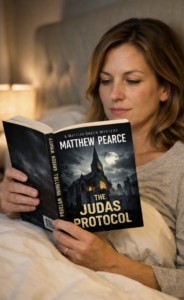
A strong thriller does more than hand the reader a mystery. It creates pressure. It makes every page feel like a deeper step into something hidden, dangerous, and morally unstable. Mathias Green: The Judas Protocol works because it understands that suspense is not only about what happened, but about what people are willing to protect, deny, and bury. The published premise centers on theology professor Silas Hawthorne, found dead in a locked archive vault, and on Mathias Green’s investigation into a suppressed Latin text tied to earlier Vatican-linked deaths. That setup gives the novel immediate weight, and it gives the reader a reason to lean in from the first beat.
For readers who gravitate toward psychological suspense novels, this book has the right ingredients: intellectual intrigue, spiritual unease, institutional secrecy, and a protagonist who is clearly built to question official answers instead of accepting them. What makes this title especially appealing is that it does not appear interested in cheap shock. It aims for a darker and more lasting kind of tension, the kind that comes from silence, buried truth, and the unsettling possibility that knowledge itself can become a weapon.
A Premise That Immediately Earns Attention
The opening concept is one of the novel’s greatest strengths. A dead professor. A locked archive vault. No wounds. No struggle. One uncatalogued manuscript. That combination is sharp, visual, and intelligent. It gives the story a classic mystery engine, but it also introduces an atmosphere that feels more theological and psychological than procedural. The result is a premise with real identity. It does not read like a recycled thriller outline. It reads like a story built around belief, secrecy, and control.
That matters in a crowded fiction market. Readers who follow literary and review coverage through places like Publishers Weekly, Kirkus Reviews, and Book Marks tend to notice when a novel can signal its tone and stakes quickly. The Judas Protocol does that well. Before the larger conspiracy even fully unfolds, the premise already suggests layered danger: private archives, religious institutions, unrecorded texts, and deaths that may be part of an older pattern. Those are not random thriller decorations. They imply a story in which meaning matters as much as action.
What makes the setup especially effective is its discipline. The novel does not need explosions in its premise to feel urgent. It uses confinement, secrecy, and anomaly. That choice gives the review an easy starting point: this is a suspense novel that appears to trust atmosphere and implication. In practical terms, that is one reason the title feels review-worthy. The best book discussions often begin with a premise that can be summarized cleanly while still sounding original, and this book has that advantage.
Why the Psychological Dimension Feels Strong
A true psychological suspense story does not rely only on external danger. It depends on tension inside the reader’s mind and inside the characters’ moral world. This is where The Judas Protocol looks especially promising. The central conflict is not simply “solve the death.” It is “enter a place where truth has been controlled for a long time and determine whether that control exists for protection, corruption, or both.” That creates a deeper strain of suspense than a standard chase novel.
The manuscript itself is a strong device because it carries meaning before the reader even knows its full content. According to the published description, the phrase at the center of The Judas Protocol is not a prayer and not a confession. It is instruction. That single idea changes the emotional temperature of the story. It suggests intent. It suggests ritual or design. It suggests that the danger is not merely historical but active. That is exactly the kind of detail that gives psychological suspense its staying power.
There is also something compelling about the religious-academic setting. A seminary is a place associated with discipline, reverence, scholarship, and formation. Setting a mystery there immediately creates friction between surface order and hidden disorder. Suspense becomes stronger when the location itself carries moral symbolism, and St. Ignatius Seminary seems to do that for this novel. It is not just a backdrop. It appears to function as part of the story’s emotional architecture.
Readers who enjoy thoughtful criticism often return to review spaces like The New Yorker’s book reviews, Literary Hub, and Book Riot because those spaces tend to reward books that have both narrative pull and interpretive depth. The Judas Protocol looks like the kind of novel that invites that sort of conversation. It seems built not only for plot consumption, but for post-reading reflection.
Mathias Green Feels Like the Right Kind of Lead
A suspense novel rises or falls on the credibility of the person carrying the investigation. Here, Mathias Green seems particularly well suited to the material. The description tells us plainly that he does not believe in anomalies. That is a simple line, but it does a lot of work. It defines him as someone resistant to comforting explanations. He is not there to be impressed by mystery. He is there to dismantle it.
That is a smart character foundation for a book like this. In stories involving old texts, institutional secrecy, and death patterns, a weaker protagonist can easily be overwhelmed by atmosphere. But a skeptical, pattern-seeking lead gives the narrative stability. The reader can enter strange territory without losing confidence because the investigator is grounded by method. In review terms, that balance matters. A protagonist who chases truth instead of theatrics makes a suspense novel feel stronger, sharper, and more trustworthy.
Mathias Green also appears to occupy a useful middle ground between outsider and insider. He is summoned into the setting, which gives him access, but he is not emotionally captive to the institution’s official story. That creates the best kind of investigative tension. He is close enough to see what others miss, but distant enough to question what insiders might excuse. For a novel concerned with suppressed material and repeated deaths, that perspective is exactly what keeps the story from collapsing into either blind reverence or cynical noise.
The Novel’s Real Strength Is Its Blend of Intellect and Dread
What separates a forgettable thriller from a memorable one is often not the number of twists, but the quality of its pressure. The Judas Protocol seems designed around a specific blend of intellect and dread. The intellectual side comes from manuscripts, theology, archives, and coded meaning. The dread comes from death, repetition, suppression, and the feeling that something old is still operational in the present. That combination is potent because it allows the book to satisfy two reader desires at once: the desire to think and the desire to fear.
This is also where the title itself deserves credit. “The Judas Protocol” is an excellent suspense title because it sounds both theological and procedural. “Judas” evokes betrayal, conscience, rupture, and religious memory. “Protocol” suggests system, method, policy, and deliberate action. Put together, the phrase feels cold, sacred, and dangerous at the same time. A strong review notices when a novel’s title is doing thematic work, and this one clearly is.
As Wikipedia’s overview of book review notes, a review is more than a recap; it is an evaluation of content, style, and merit. By that standard, one of the clearest merits of The Judas Protocol is how coherently its concept appears to be assembled. The components fit one another. A theology professor belongs in this world. A locked archive belongs in this world. A suppressed Latin text belongs in this world. Vatican-linked deaths belong in this world. That internal coherence is not a small thing. It is one of the reasons the novel feels serious rather than gimmicky.
Why This Book Stands Out in the Suspense Conversation
There are many thrillers that promise secrets. There are many mysteries that promise shocking revelations. What makes Mathias Green: The Judas Protocol more interesting is that it appears to promise consequence. The story is not framed as a puzzle floating in empty entertainment space. It is framed as an encounter with systems of concealment, belief, language, and power. That gives the book a denser tone and a more distinctive lane.
It also gives the novel broader appeal. Some readers come to suspense for pace. Others come for mood. Others want a story that lets them think about ethics, institutions, and human weakness while still delivering momentum. This novel appears positioned to serve all three groups. It has the locked-room intrigue that mystery readers enjoy, the moral tension that psychological suspense readers look for, and the intellectual shading that makes a thriller feel elevated without becoming inaccessible.
That is why this book review lands on a positive conclusion. The Judas Protocol presents itself as a thriller with a mind, but not one that forgets to grip the reader. It leans into secrecy, faith, scholarship, and betrayal without losing narrative urgency. It understands that fear becomes more effective when it is attached to meaning. It understands that silence can be more unnerving than spectacle. And it understands that a protagonist who refuses easy explanations can carry a reader through increasingly dark territory.
Conclusion
Book Review of Mathias Green: The Judas Protocol ends in a strong place because the novel itself appears to begin in one. From its locked-vault death to its forbidden manuscript and Vatican-shadowed implications, the book offers the kind of premise that naturally generates suspense while still feeling thoughtful and controlled. It is dark without sounding chaotic, intellectual without sounding dry, and mysterious without feeling vague.
For readers looking for a thriller that seems built on atmosphere, ideas, and escalating unease, The Judas Protocol looks like a highly worthwhile read. It has the bones of a compelling mystery, the mood of a psychological page-turner, and the thematic ambition that helps a suspense novel stay with you after the final chapter. That is why it earns real attention as a standout entry among modern suspense fiction.